Camera Angles and Card Shuffles: Inside the Tech Powering Live Dealer Casino Games
Camera Angles and Card Shuffles: Inside the Tech Powering Live Dealer Casino Games

The Rise of Live Dealer Tech in Online Casinos
Live dealer casino games blend the thrill of brick-and-mortar casinos with digital convenience, relying on sophisticated camera systems, shuffling mechanisms, and streaming protocols to deliver real-time action to players worldwide. Providers like Evolution and Playtech operate dedicated studios where dealers handle games such as blackjack, roulette, and baccarat, while high-definition feeds stream directly to apps and websites. Data from the Malta Gaming Authority shows live dealer revenues surpassing $5 billion globally in 2025, a figure expected to climb as bandwidth improves and mobile penetration deepens.
What's interesting here involves the invisible layers of tech ensuring every hand feels authentic; cameras capture nuanced dealer movements, shufflers maintain randomness under scrutiny, and software processes bets instantaneously. Observers note that these elements mimic Las Vegas floors, yet scale to thousands of simultaneous tables without physical limits.
And as studios expand—take Evolution's new facility in the Philippines, which went live in early 2026—players access 24/7 games from regions like North America and Europe, all compliant with local regs.
Precision Camera Angles: Capturing Every Detail
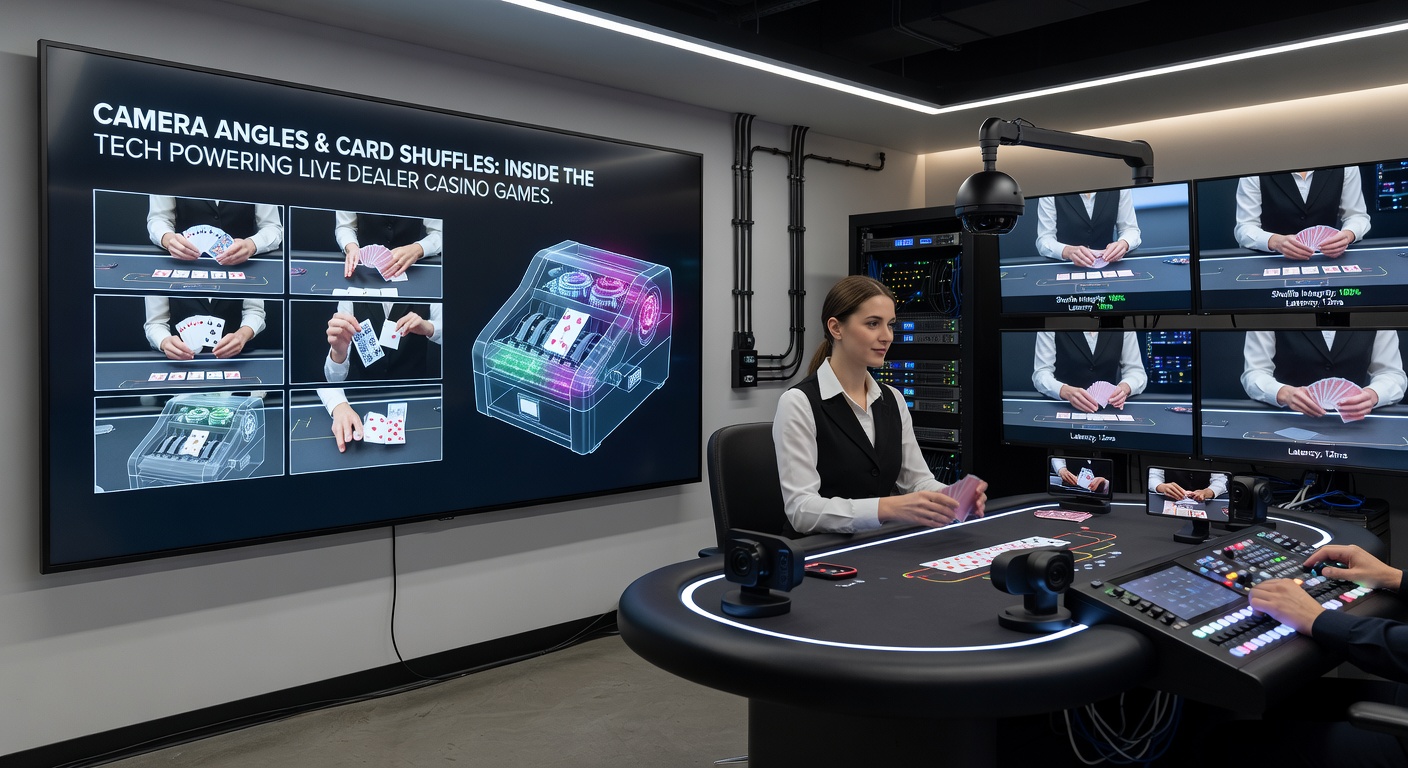
Multiple high-end cameras, often numbering seven to twelve per table, position strategically around live dealer setups to provide immersive views without blind spots; overhead shots reveal full table layouts, side angles track card deals, and close-ups zoom on shoe contents or roulette wheels. Manufacturers like Grass Valley and Sony supply these broadcast-grade units, equipped with 4K sensors that adjust focus dynamically via AI-driven motors, ensuring clarity even under studio lighting variances.
But here's the thing: angle selection follows strict protocols; for blackjack, a top-down camera verifies initial card distributions, while a player-perspective feed simulates sitting at the table, fostering trust through transparency. Research from the Nevada Gaming Control Board highlights how such multi-angle systems reduce disputes by 40%, as players witness shuffles and payouts in real time.
Take one setup at Pragmatic Play's Bucharest studio, where robotic pan-tilt-zoom heads swivel silently, tracking dealer hands with sub-millimeter precision; this tech, powered by fiber-optic cabling, delivers latency under 100 milliseconds to end-users, making interactions feel immediate despite transatlantic distances.
Yet challenges persist—glare from table felts or dealer gestures can obscure views, so operators employ polarizing filters and infrared assists, techniques borrowed from sports broadcasting where every frame counts.
Advanced Card Shuffling: Randomness Meets Automation
Card shuffles in live dealer environments combine human dealers with continuous shuffling machines (CSMs), devices that automate the process to prevent predictability while allowing visual verification; these units, like those from SHFL Entertainment, cycle decks through interleaving rollers, emerging in randomized order for immediate redeal. Figures reveal CSMs handle up to 80 hands per hour, boosting table efficiency without compromising fairness.
RFID-embedded cards add another layer, with microchips in each playing card broadcasting unique IDs to overhead scanners, enabling real-time tracking from shuffle to payout; this setup flags duplicates or missing cards instantly, a safeguard studios in Malta and Latvia deploy routinely. And while traditional riffle shuffles by dealers build player rapport, tech intervenes subtly—sensors detect improper handling, triggering alerts to remote supervisors.
One case from Playtech's operations showed how OCR cameras, scanning card faces at 60 frames per second, cross-verify shuffles against RNG benchmarks, ensuring outcomes match statistical expectations; studies by gaming labs confirm these hybrids achieve entropy levels rivaling physical casinos.
Turns out, April 2026 marks a pivot as providers roll out next-gen shufflers with blockchain logging, timestamping every mix for auditable trails—a move regulators in Ontario applaud for enhancing cross-border compliance.
Streaming Backbone: Low-Latency Delivery and Software Integration
High-capacity encoders compress feeds into adaptive bitstreams, routing them via content delivery networks (CDNs) like Akamai or Cloudflare to minimize buffering; dual-stream tech separates video from audio, allowing chat overlays and bet interfaces to layer seamlessly. Players interact through HTML5 clients that sync actions with dealer states, processing side bets or insurance in under a second.
Software platforms from companies like EveryMatrix orchestrate this, fusing frontend UX with backend APIs that tally wagers across currencies; data indicates 99.9% uptime, thanks to redundant servers in data centers from Sweden to Singapore.
But security weaves through it all—end-to-end encryption shields streams, while biometric logins (fingerprints, facial scans) gatekeep accounts; experts who've dissected breaches note how tokenization prevents session hijacks, even on public Wi-Fi.
Security and Fairness: AI Vigilance in the Studio
Behind the glamour, AI algorithms monitor for collusion by analyzing bet patterns across tables, flagging anomalies like mirrored plays from linked IPs; meanwhile, human oversight persists via control rooms where pit bosses watch multiple feeds, intervening via earpieces if dealers falter. Optical character recognition (OCR) reads every card and chip value, logging results to immutable databases for post-game audits.
Regulators demand this rigor; the Alcohol and Gaming Commission of Ontario mandates quarterly RNG certifications for live ops, a standard echoed in Australian jurisdictions where live dealer growth hit 25% year-over-year in 2025.
People often overlook the human-tech hybrid: dealers train on simulators mimicking peak loads, while wearables track fatigue, swapping shifts to maintain focus; one studio in Georgia, USA, reported zero procedural errors after implementing such protocols.
What's significant involves geofencing software, blocking access in restricted zones while localizing languages and odds—essential as markets like Brazil eye legalization in 2026.
Global Studios and Scalability: From Latvia to Emerging Hubs
Studios cluster in cost-effective locales—Riga, Latvia hosts over 100 tables for Evolution, its neutral time zone serving Europe and Asia; Manila's facilities cater to high-rollers with VIP enclosures, featuring 360-degree cams for bespoke angles. Expansion continues, with new builds in Costa Rica and the US (post-PASPA) incorporating VR-ready rigs.
And scalability shines: a single table supports infinite virtual seats via picture-in-picture tech, multiplying revenue without extra floor space; data from industry reports pegs this model as driving 60% of online casino play by mid-2026.
Challenges like bandwidth in developing regions prompt edge computing solutions, processing streams locally before uplink—a tactic proving vital in Africa's nascent markets.
Conclusion
Camera angles and card shuffles form the core of live dealer tech, powering an industry that delivers verifiable, engaging casino experiences at scale; from AI-enhanced optics to RFID shuffles and ultra-low latency streams, these innovations ensure fairness and immersion. As April 2026 unfolds with fresh studio launches and regulatory nods across continents, the sector positions for broader adoption, blending cutting-edge hardware with rigorous oversight. Observers expect refinements like 8K feeds and haptic feedback to elevate it further, keeping players hooked on that authentic casino pulse.